
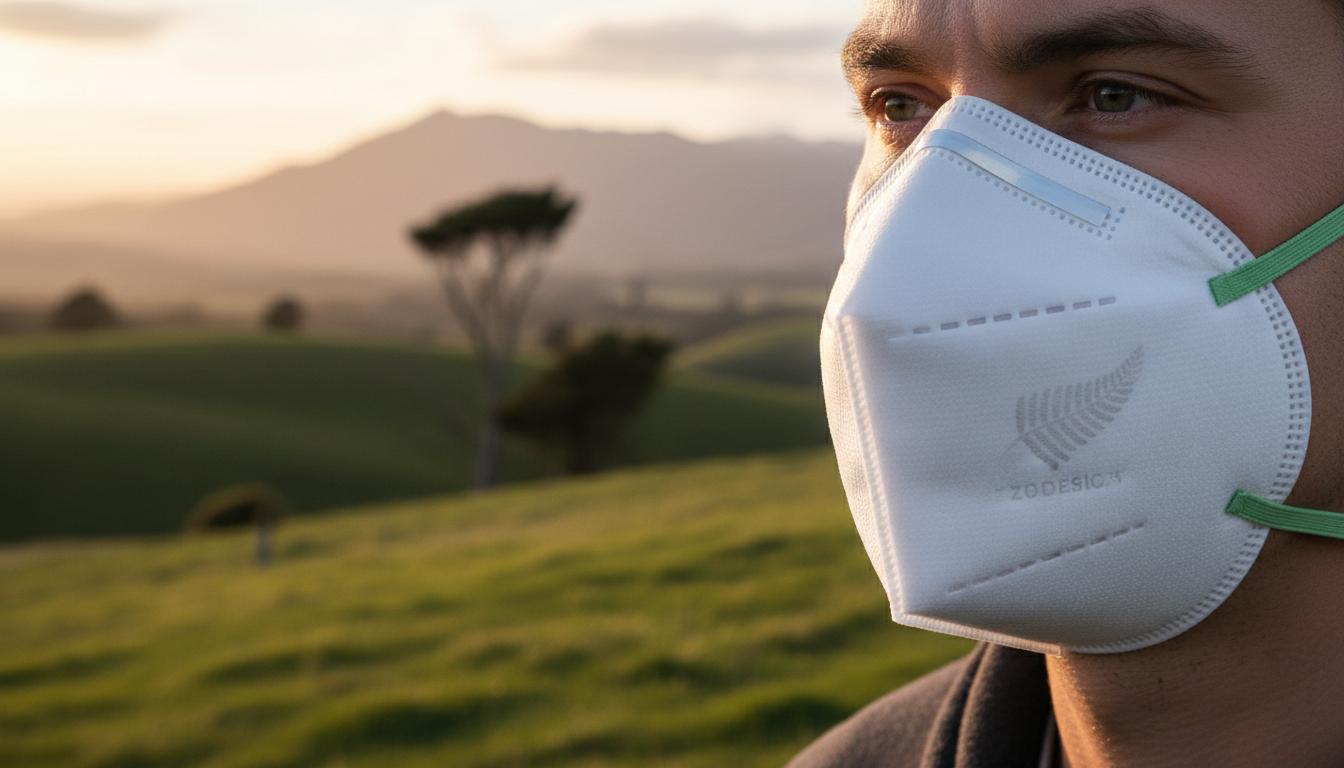
If you’re weighing up a better mask for travel, wildfire smoke, construction dust, or winter viruses, the N95 sits near the top of the list. This guide breaks down what an N95 is, how it works, how it compares with P2 and other options common in New Zealand, when it makes sense to use one, and how to choose the right fit. You’ll also find a quick comparison table and simple step-by-step instructions so you can use your N95 mask with confidence in NZ.
What is
An N95 is a tight-fitting respirator that filters at least 95% of very small airborne particles when properly fitted. “N95” is a U.S. standard approved by NIOSH (the National Institute for Occupational Safety and Health). The N95 is different from a surgical or community mask: it seals to the face and is designed for personal protection against airborne hazards.
In New Zealand, the closest local standard is P2 under AS/NZS 1716. Both N95 and P2 are high-efficiency particulate filtering respirators. For workplaces, WorkSafe NZ expects you to follow AS/NZS 1715 for selection, use, and maintenance—including fit testing for tight-fitting respirators. In many non-clinical settings, a genuine N95 or a P2 will provide similar protection when you get the fit right.
How it works
An N95 filters tiny particles through multiple layers of non-woven polypropylene. The fibres are arranged to catch particles in several ways:
- Impaction and interception: larger particles hit or brush against fibres and get trapped.
- Diffusion: the smallest particles move randomly and bump into fibres.
- Electrostatic attraction: the filter media carries a charge that helps pull in particles.
Fit matters as much as the filter. If air leaks around the edges, unfiltered air bypasses the media. That’s why N95s use head straps, not ear loops, and why a quick “fit check” each time you put one on is essential. Models with exhalation valves can feel cooler to breathe out through, but the valve lets unfiltered air escape; that’s not suitable where source control is required (for example, in many healthcare settings).
Types / examples
N95 styles you’ll see in NZ
- Cup-shaped: rigid dome, durable, often great seal once fitted.
- Flat-fold (often called “Aura-style”): folds flat for a pocket or bag, opens into a tight fit with a nose foam strip.
- Duckbill: roomy, good for talking, can fit some face shapes well.
Genuine N95s approved by NIOSH have two headbands (not ear loops), a NIOSH mark, the “N95” designation, and an approval number (format TC-84A-xxxx) printed on the mask body. Beware of listings that say “N95-style” or show only ear loops—those are red flags.
Related standards you’ll encounter
- P2 (AS/NZS 1716): Local standard widely sold in hardware and safety stores for dust, smoke, and workplace hazards.
- KN95 (GB 2626-2019): Chinese standard. Quality varies; many use ear loops, which can compromise the seal.
- KF94 (KMOEL): Korean standard with a distinct “boat” shape. Typically ear-looped; good filtration but harder to seal tightly.
- FFP2/FFP3 (EN 149): European standards. FFP3 filters more than FFP2 and N95 but can be harder to find here.
Where to buy in New Zealand
You can find N95 and P2 respirators at pharmacies, safety suppliers, and hardware chains across the country, as well as reputable NZ-based online stores. For construction or DIY, P2s are common at hardware stores. For travel and health, look for NIOSH-approved N95s or P2s from established safety brands. Always check the approval markings, packaging, and supplier reputation to avoid counterfeits.
Quick comparison
| Type | Standard | Minimum filtration | Fit style | Source control | Common in NZ | Best for |
|---|---|---|---|---|---|---|
| N95 | NIOSH (USA) | ≥95% of 0.3 µm particles | Tight seal, headbands | Yes (non-valved) | Yes | Travel, healthcare, higher-risk indoor air |
| P2 | AS/NZS 1716 | Comparable to N95 | Tight seal, headbands | Yes (non-valved) | Very common | Worksites, smoke, dust, general protection |
| KN95 | GB 2626-2019 | ≈N95 on paper | Often ear loops | Yes (non-valved) | Common online | Everyday use if seal is acceptable |
| KF94 | KMOEL (Korea) | ≈94% | Ear loops | Yes (non-valved) | Available | Comfort and consistent quality from known brands |
| Surgical mask | Medical device standard | Fluid resistance; not a respirator | Loose-fitting | Yes | Very common | Source control, basic protection |
Pros and cons
Advantages
- High filtration efficiency when sealed correctly.
- Consistent performance from certified models (N95 or P2).
- Better protection in crowded indoor spaces, wildfire smoke events, and dusty worksites.
- Headband design reduces gaps compared with most ear-loop masks.
Limitations
- Requires a good facial seal; beards break the seal.
- More breathing resistance than loose masks; can feel warm.
- Communication is harder; voices sound muffled.
- Counterfeits exist; checking authenticity takes a moment.
- Valved models are not suitable where your exhaled air must be filtered.
How to use or choose
How to choose an N95 mask in NZ
- Match the standard to the risk: N95 or P2 for fine particles and higher-risk indoor air; surgical masks for basic source control.
- Check approvals: look for NIOSH markings (N95) or AS/NZS 1716 (P2) on the mask and packaging.
- Pick the right style: try cup, flat-fold, and duckbill to see which seals best on your face.
- Prioritise headbands: they pull the respirator evenly to the face for a better seal.
- Avoid valves if you need your exhaled air filtered (healthcare, shared indoor spaces).
- Buy from trusted NZ retailers or safety suppliers to reduce counterfeit risk.
- Workplaces: arrange a fit test as required by AS/NZS 1715 and WorkSafe NZ guidance.
Step-by-step: putting on an N95 and doing a fit check
- Clean your hands and inspect the mask. Do not use it if the straps are loose, the nose wire is broken, or the filter is damaged or wet.
- Cup the mask in your hand with the nose piece at your fingertips and the straps hanging below.
- Place the mask on your face, covering nose and mouth. Pull the bottom strap over your head and position it below your ears, around the neck.
- Pull the top strap over your head and rest it high on the crown of your head, above your ears. Straps must not cross.
- Mould the nose wire firmly with both hands to the shape of your nose and cheeks.
- Fit check: place your hands gently over the mask and breathe in and out. You should feel the mask collapse slightly on inhale and expand on exhale, with no air leaking around the edges. Adjust the nose wire and strap position until leaks stop.
- Re-check after talking or moving; readjust if needed.
Taking it off safely
- Clean your hands. Avoid touching the front of the mask.
- Lift the bottom strap over your head, then the top strap, and pull the mask away from your face.
- Discard if dirty, wet, damaged, or after workplace use as per your policy.
Care and replacement
- These are single-use products. In non-clinical settings, some people keep a respirator for several outings if it stays clean and dry; follow workplace policies where applicable.
- Do not wash or spray the filter material with alcohol or disinfectants—they can damage the electrostatic layer.
- Store a dry respirator in a clean, breathable container (for example, a paper bag) between uses, and keep it away from dust and oils.
- Replace if breathing becomes hard, the mask loses shape, the nose foam detaches, straps loosen, or you notice odours or soil inside.
FAQ
Is an N95 allowed for workplace use in NZ?
Yes, provided it is genuine and appropriate for the hazard. WorkSafe NZ requires tight-fitting respirators to be fit tested and used under a respiratory protection programme consistent with AS/NZS 1715. P2 is the local standard, but NIOSH-approved N95s are typically acceptable for equivalent protection if they fit you well and meet your employer’s policy.
N95 vs P2—what should I pick?
Pick the one that fits your face best and matches the task. Both offer similar filtration when certified and correctly fitted. In practice, availability and fit decide. For construction and dust, P2s are widely stocked. For travel or healthcare, NIOSH-approved N95s and P2s from reputable brands are both strong choices.
Do ear-loop “N95” masks count?
No. NIOSH-approved N95s have headbands and required markings on the mask body. Ear-loop products may still filter well, but they’re not NIOSH N95s and often leak at the cheeks. If you buy KN95 or KF94 with ear loops, use clips or adjusters to reduce gaps, but understand they’re not a substitute for a fitted respirator.
How can I reduce glasses fogging?
- Mould the nose wire firmly and smooth the top edge.
- Seat the top of the mask high on the nose, then rest glasses on top to help seal.
- Use models with a foam nose bridge for better contouring.
Can children use N95 masks?
NIOSH does not approve child-sized N95s. In NZ, look for smaller P2 or high-filtration masks designed for smaller faces and follow manufacturer guidance. Comfort and a reasonable seal matter more than the label here.
How long can I wear one?
Many people comfortably wear a respirator for several hours. Replace it sooner if it gets damp, dirty, damaged, or breathing becomes difficult. For workplaces, follow your respiratory protection programme.
Are valves okay?
Valves ease exhalation and heat, but they vent unfiltered breath. Avoid valves where your exhaled air needs to be filtered (for example, healthcare or crowded indoor spaces). They’re fine for dusty work where source control is not a requirement.
What if I have a beard?
Beards break the seal of any tight-fitting respirator (N95, P2, etc.). For reliable protection, shave where the respirator seals or use a powered air-purifying respirator (PAPR) with a loose-fitting hood as directed by your workplace.
Where can I buy an N95 mask in NZ?
Look for NIOSH-approved N95 or certified P2 respirators at pharmacies, safety suppliers, and major hardware stores, as well as reputable NZ online retailers. Search “n95 mask nz” to find local stock, then verify markings on the product before purchase.
How do I spot a counterfeit?
- Check for the NIOSH name, N95, and the TC-84A-xxxx approval number printed on the mask.
- Be cautious of ear-loop “N95s,” typos on packaging, or vague seller details.
- Cross-check the model number on the manufacturer’s website or the NIOSH Certified Equipment List.
Bottom line for New Zealanders
If you want stronger personal protection, choose a certified N95 or P2 that seals well on your face. Buy from trusted NZ retailers, check the markings, skip valves when you need source control, and do a quick fit check every time. With those habits, an N95 mask in NZ can deliver the level of protection you’re actually paying for.