
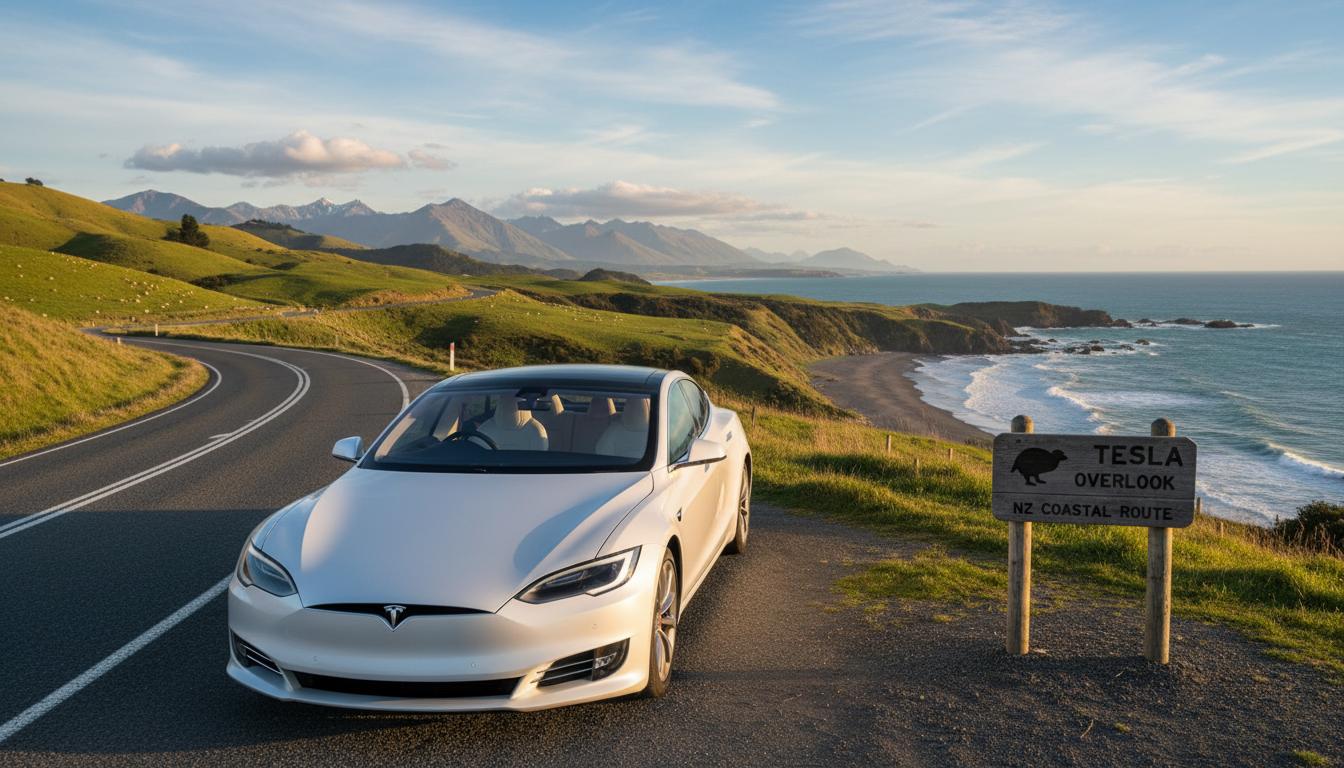
Thinking about going electric in Aotearoa? Tesla NZ has made the switch easier: simple online ordering, a growing Supercharger network, and two well-sorted models that suit most Kiwi roads. In this guide you’ll learn what Tesla offers in New Zealand, how the cars and charging work here, which model fits your life, true pros and cons, and how to buy with confidence.
What is
Tesla NZ is the local arm of Tesla that sells and supports its electric vehicles and energy products across New Zealand. The current new-vehicle focus is Model 3 (sedan) and Model Y (compact SUV). You’ll still see Model S and Model X on the used market, but Tesla no longer builds right-hand-drive versions new.
Beyond cars, Tesla NZ supports home charging with the Wall Connector and partners with installers nationwide. The company also offers Powerwall home batteries through certified installers, which can pair with solar from local providers.
Charging is where Tesla NZ stands out. The Supercharger network spans both islands and keeps growing, while public third-party networks—ChargeNet, BP Pulse, Z Energy and others—fill gaps. Every current Tesla sold here uses Type 2 for AC and CCS2 for DC fast charging, so you’re not locked into one network.
How it works
Under the bonnet (even if there isn’t one)
A Tesla is a battery, one or two electric motors, power electronics, and software tying it all together. Press the accelerator and the motor delivers instant torque; lift off and regenerative braking recovers energy back into the battery. Over-the-air updates add features and refinements without a workshop visit.
Charging in New Zealand
- Home: Most owners install a Wall Connector for 7–11 kW AC (circuit and supply dependent). On a typical overnight charge you’ll add hundreds of kilometres of range while you sleep.
- Public AC: Type 2 posts in malls, workplaces and council sites are handy top-ups.
- Fast DC: CCS2 stations and Tesla Superchargers handle rapid trips. Many Superchargers are now open to non-Tesla EVs; Tesla drivers pay and start charging automatically via the car or app.
Paying and planning
- Superchargers bill per kWh in the Tesla app; pricing varies by site and time.
- Third-party networks use their own apps/RFIDs.
- The in-car Trip Planner routes you via chargers with live availability where supported.
Ownership basics in NZ
- Road user charges (RUC): Light EVs now pay RUC per 1,000 km, set and managed by Waka Kotahi NZTA. Buy RUC in the NZTA portal or at participating outlets.
- Warrant of Fitness: New cars get an initial longer WOF period, then annual checks (standard NZ rules apply).
- Warranty: New Teslas include a vehicle warranty (typically 4 years/80,000 km) and a battery/drive unit warranty (typically 8 years with a kilometre limit depending on variant).
Types / examples
The Tesla NZ lineup
- Model 3: Low, sleek sedan. Quiet, efficient, sharp steering. Great for commuters and road-trippers who don’t need SUV height.
- Model Y: Compact SUV with a big hatch opening and higher seating. Family favourite thanks to cargo space and towing capacity.
Trims you’ll commonly see
- Rear-Wheel Drive (RWD): Excellent value, urban-friendly efficiency. Often uses an LFP battery chemistry that’s happy with regular 100% charges—ideal for maxing range before a trip.
- Long Range (AWD): Dual motors, more power, larger battery, longer touring range.
- Performance (AWD): Lower ride, bigger brakes, the quickest acceleration. Best if you love a backroad blast or want track-day fun.
Real NZ use-cases
- Auckland commuter: Home charging covers weekdays; a quick weekend top-up at a Supercharger keeps you set without queuing at service stations.
- Intercity runs: Auckland–Wellington via Taupō is straightforward with Superchargers and CCS2 along SH1/SH3. Ferries carry EVs across Cook Strait—book early in holidays.
- South Island touring: Christchurch to Queenstown is well served; add a destination charge overnight and you’ll wake up “full.”
Model 3 vs Model Y at a glance
| Feature | Tesla Model 3 | Tesla Model Y |
|---|---|---|
| Body style | Sedan (boot + frunk) | Compact SUV (large hatch + frunk) |
| Seating position | Lower, sportier | Higher, easier entry |
| Cargo flexibility | Adequate for two adults + gear | Family-friendly, prams and bikes fit easier |
| Towing (braked) | Up to ~1,000 kg (variant dependent) | Up to ~1,600 kg (variant dependent) |
| Ride/handling | More planted, agile | Comfort-biased, stable |
| Typical WLTP range | Roughly 400–600 km depending on trim | Roughly 400–530 km depending on trim |
| Best for | Efficiency, dynamics, sleek look | Space, versatility, towing |
Pros and cons
What Tesla NZ gets right
- Charging confidence: Superchargers plus CCS2 access cover both islands.
- Low running costs: Electricity (especially off-peak) and minimal servicing beat petrol spend for most Kiwis.
- Software-first: Over-the-air updates improve range estimates, UI, and features over time.
- Safety: Model 3 and Model Y have strong crash-test results and active safety tech.
- Resale: Demand for used Teslas in NZ remains healthy, especially for well-kept cars.
Where to look twice
- Ride firmness: Performance wheels/tyres can feel busy on coarse-chip rural roads.
- Driver assistance limits: Autopilot is helpful, but you must supervise at all times. Feature availability may differ by NZ regulations.
- Road user charges: EVs now pay RUC, so include this in your cost-of-ownership maths.
- Accessories/repair: Panel repairs require qualified shops; order lead times for parts can vary.
- No purchase rebate: The Clean Car Discount has ended, so there’s no current government purchase incentive.
How to use or choose
Step-by-step: Buying and setting up a Tesla in NZ
- Define your needs: Daily commute length, family size, towing, parking space, budget.
- Pick the model: Model 3 for efficiency and handling, Model Y for space and height.
- Choose the trim: RWD for value, Long Range for touring, Performance for speed—match to how you actually drive.
- Check the Tesla NZ configurator: Prices and delivery estimates change; lock in what suits you.
- Plan charging at home: Talk to a licensed electrician about a dedicated circuit and a Wall Connector. Confirm your switchboard capacity and whether three-phase is available.
- Sort finance and insurance: Compare bank loans and EV-friendly insurance policies. Confirm cover for accessories and glass.
- Order and schedule delivery: Upload documents in the Tesla app; arrange trade-in or private sale if needed.
- Prepare for RUC: Create or update your NZTA account and buy initial RUC distance.
- Collect and inspect: Walk around the car, check panels, trim, charger, and accessories. Note anything in the app immediately.
- Set up the app and profiles: Pair phone key, add a backup key card, configure charging limit (80–90% for NMC packs; LFP packs can be 100% daily), and enable off-peak charging.
Practical tips for life with a Tesla NZ
- Charge smart: Time-of-use plans can slash costs. Set scheduled charging to off-peak.
- Road trips: Leave with a warm battery and full charge; the car preconditions before fast charging for quicker stops.
- Tyres: EV torque eats cheap tyres. Choose EV-rated rubber and rotate regularly.
- Weather: In winter, preheat while plugged in. Expect some range loss in cold or strong southerlies.
- Towing and loads: Stay within rated limits; range will drop. Plan extra charging stops.
FAQ
Is Tesla NZ still selling Model S or Model X new?
No. New right-hand-drive production has stopped. You can buy used imports via dealers or private sellers.
What connector do Tesla cars use in New Zealand?
Type 2 for AC and CCS2 for DC fast charging. That works across Tesla Superchargers and most public networks.
How fast do Teslas charge at Superchargers here?
Many NZ sites are high-power units capable of very rapid charging. Real speed depends on battery state, temperature, and site load. The car manages everything automatically.
Can I charge to 100% every day?
If your Tesla has an LFP battery (commonly in RWD variants), regular 100% charges are fine. For other chemistries, daily limits around 80–90% are recommended; charge to 100% before long trips.
What does ownership cost versus petrol?
Most Kiwi owners spend far less on energy and servicing than a comparable petrol car. Include RUC, tyres, insurance, and electricity in your calculation for an accurate picture.
Are there EV rebates in NZ?
No current nationwide purchase rebate. The Clean Car Discount ended. Some councils or lines companies may offer small incentives for home energy gear—check locally.
Does Autopilot drive the car for me?
No. It’s driver assistance. You must pay attention and be ready to take over at all times. Feature sets depend on NZ regulations and software version.
How often do Teslas need servicing?
There’s no fixed oil-change schedule. Rotate tyres, replace cabin filters and brake fluid on condition, and keep software up to date. The car flags what it needs in the app.
What about inter-island travel?
EVs are fine on the ferry. Book your spot, arrive with a buffer, and plan a top-up near the terminal on each side.
How long do the batteries last?
Tesla backs the battery and drive unit for up to eight years (with a kilometre cap by variant). Some capacity loss over time is normal; many owners report useful range well past the warranty window.
Can I use non-Tesla fast chargers?
Yes. All current Tesla NZ vehicles support CCS2. Use the provider’s app or RFID to start a session.
Final thoughts
If you want an EV that’s easy to buy, easy to charge, and genuinely good to drive, Tesla NZ makes a strong case. Pick the model that fits your life, set up home charging, factor RUC into your maths, and you’ll likely wonder why you waited. The rest—software updates, quiet mornings, and fewer fuel stops—comes as a very welcome bonus.