
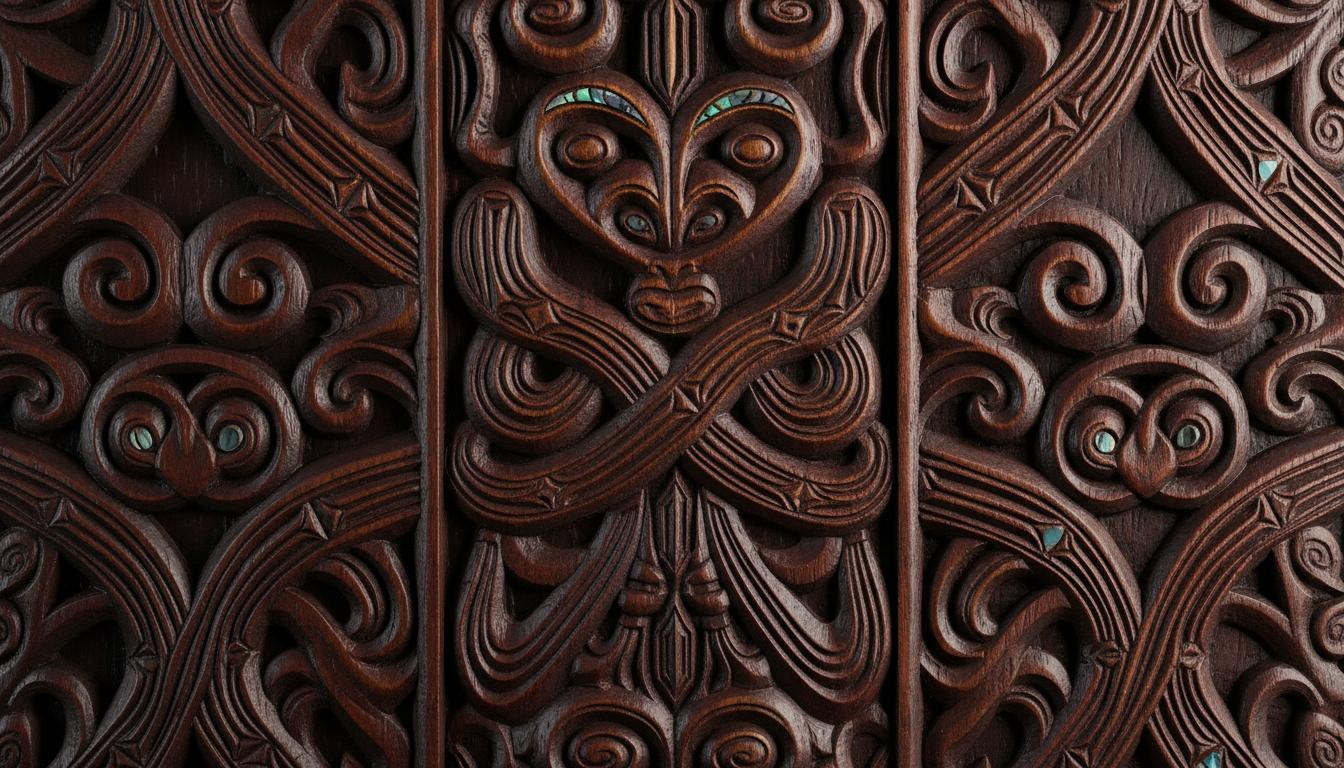
From wharenui rafters to kapa haka kākahu and public signage, Māori patterns are a living visual language in Aotearoa New Zealand. They signal place, whakapapa, and values. This guide explains what Māori patterns are, how the design system works, the main types you’ll see, when and how to use them respectfully, and the common pitfalls to avoid.
What is
Māori patterns are recurring visual motifs and arrangements used across Māori arts and design. They appear in kōwhaiwhai (rafter painting), tukutuku (woven panels), tāniko (finger-woven bands), and whakairo (carving). Each pattern carries story and connection—often to ancestors, local landscapes, or kaupapa—rather than being “just decoration.”
The best-known motif is the koru, a spiral inspired by the unfurling silver fern frond. Other well-known patterns include poutama (stepped forms), niho taniwha (triangles/teeth), purapura whetū (star seeds), roimata toroa (albatross tears), and unaunahi (fish scales). Meanings can vary between iwi and hapū, so context matters.
Important distinction: Māori patterns used in art and design are different from tā moko (customary tattooing). Do not copy tā moko facial designs, or use moko-style patterns in logos or products. That breaches tikanga and can cause harm.
How it works
Māori pattern systems rely on rhythm, repetition, and balance. Designers build patterns from core elements—line, curve, notch, stitch—then repeat, mirror, or interlock them to create flow and narrative. Positive and negative space are equally active: the “in-between” shapes carry as much voice as the lines.
Structure and symmetry
Patterns often use bilateral symmetry (mirrored halves) or alternating repeats across a field. In kōwhaiwhai, koru forms sweep along heke (rafters), creating movement and dialogue between parent and child forms. In tukutuku, the stitch path maps journeys across a lattice, forming diagonals, steps, or diamonds with precise counting.
Colour and contrast
Traditional kōwhaiwhai uses red, black, and white for strong contrast, with red ochre (kōkōwai) historically important. Tukutuku and tāniko rely on contrasting fibre colours to reveal geometry. Carving plays with light and shadow more than colour, using cut profiles to throw highlights and deepen grooves.
Techniques as “grammar”
Whakairo uses named cuts that function like a grammar of texture:
- Haehae: parallel grooves that set rhythm.
- Pākati: serrated “dog-tooth” notches along a ridge.
- Unaunahi: fish-scale crescents for flow and abundance.
- Rauru and rauponga: spiral plait and ridged bands combining haehae and pākati.
In weaving, the grammar is stitch and count. Tukutuku uses crossed stitches of dyed harakeke or kiekie over a wooden lattice. Tāniko is finger-weaving without a loom, building geometric patterns at the edges of cloaks or belts through precise colour changes.
Tikanga and process
Pattern choice is guided by whakapapa, local narratives, and purpose. Many artists begin with kōrero, consultation, and karakia. The process can include research with kaumātua, checking regional styles, and selecting materials that fit the kaupapa. Good design embeds this respect at every stage.
Types / examples
Kōwhaiwhai (rafter painting)
Flowing koru-based patterns painted on wharenui rafters. Common forms include triple koru, mangōpare (hammerhead motif associated with strength and determination), and interweaving stems that speak to whakapapa. Modern kōwhaiwhai also appears in print, vehicles, offices, and wayfinding.
Tukutuku (woven wall panels)
Panels woven with harakeke or kiekie on a wooden lattice. Well-known patterns include poutama (ascent, striving, knowledge), roimata toroa (teardrop forms linked to memory and loss), purapura whetū (stars or seeds, growth), kaokao (chevrons, support), and pātiki (flounder, abundance). Stitch paths are highly intentional.
Tāniko (finger-woven borders)
Geometric bands on kākahu and accessories. Triangles and steps align with niho taniwha and poutama, using sharp contrast for legibility at a distance. Tāniko patterns are also seen on poi handles, belts, and taonga cases.
Whakairo (carving)
Carving on wood, bone, and stone, featuring surface patterns like rauponga, pākati, and unaunahi alongside figures. Repetition creates light-and-shadow textures that animate a carved form when viewed from different angles.
Contemporary design
Many designers today collaborate with iwi, hapū, and Māori artists to bring Māori patterns into architecture, digital interfaces, uniforms, and packaging. The strongest work ties motifs to local stories rather than using generic repeats.
| Pattern family | Context | Materials / Technique | Signature motifs | Where you’ll see it | Tikanga notes |
|---|---|---|---|---|---|
| Kōwhaiwhai | Rafters, panels | Painted, flowing repeats | Koru, mangōpare, intertwined stems | Wharenui, public art, print | Colours and layout often relate to local kōrero |
| Tukutuku | Wall panels | Cross-stitch over wooden lattice | Poutama, roimata toroa, purapura whetū, kaokao | Wharenui, schools, civic spaces | Pattern meanings vary by rohe; learn local intent |
| Tāniko | Garment borders, bands | Finger-weaving, no loom | Niho taniwha, diamonds, steps | Cloaks, belts, poi, contemporary apparel | Often linked to iwi identity through colour and form |
| Whakairo | Carving surfaces | Cut patterns, light/shadow | Haehae, pākati, unaunahi, rauponga | Waka, posts, panels, taonga | Avoid copying tā moko; carving patterns have context |
Pros and cons
Benefits of using Māori patterns
- Connects design to Aotearoa New Zealand and mana whenua.
- Signals respect for te ao Māori and can support te reo visibility.
- Provides strong legibility through rhythm, contrast, and geometry.
- Adapts well across media: print, textile, digital, and architectural scale.
- Enables storytelling beyond words, anchoring projects in place.
Risks and challenges
- Misuse or generic “clip art” can be tokenistic or offensive.
- Using tā moko elements or sacred motifs in products breaches tikanga.
- Meanings differ by iwi; assumptions can erase local identity.
- Weak consultation leads to shallow, look-alike outcomes.
- Licensing and attribution need clear agreements with artists.
How to use or choose
Step-by-step: a respectful design process
- Define purpose: write one sentence on why a Māori pattern belongs in this project.
- Identify place: note the mana whenua and local stories relevant to your site or audience.
- Engage early: contact iwi/hapū representatives or Māori designers before sketching.
- Choose a pattern family: kōwhaiwhai for flowing movement, tukutuku for counted journeys, tāniko for bold edges, or whakairo textures for form.
- Confirm meanings: discuss motifs (e.g., poutama, koru, niho taniwha) and their local relevance.
- Commission and credit: contract a Māori artist, agree on usage, budget, timelines, and attribution.
- Test and refine: check scale, contrast, and accessibility; share proofs with stakeholders.
- Document tikanga: record how, where, and why the pattern can be used, including any limits.
- Launch with kōrero: share the story alongside the design so users understand the kaupapa.
Practical tips for designers
- Use vector artwork (SVG/EPS) for crisp scale across signage and digital.
- Maintain contrast ratios for readability, especially on wayfinding.
- Avoid stretching a pattern disproportionately; adjust repeats, not shapes.
- Respect breathing space; patterns need margins to “read.”
- Do not combine random motifs; ensure a coherent whakapapa between elements.
- Avoid “all-the-motifs” collages; choose one kaupapa and do it well.
- When in schools, choose widely taught patterns and acknowledge sources; seek guidance for local stories.
If you’re outside Aotearoa, be extra careful. Generic use of maori patterns in overseas branding often misses context and can drift into appropriation. Collaborate with Māori artists and uphold their IP and kaitiakitanga.
FAQ
What does the koru mean?
The koru references a fern frond unfurling. It commonly speaks to new life, renewal, and connection. Specific meanings can be extended by colour, direction, and accompanying forms.
What is the difference between kōwhaiwhai and tukutuku?
Kōwhaiwhai is painted, flowing koru-based patterning, often on rafters. Tukutuku is woven stitching over a lattice, forming geometric steps, diamonds, and diagonals. Both tell stories, but through different techniques.
Can I use Māori patterns in a logo?
Only with care. Engage mana whenua or a Māori designer, confirm the kaupapa, and avoid tā moko elements. Get clear written permissions and attribution. A logo locks in meaning for a long time—make sure it’s appropriate.
Do I need permission to use maori patterns?
If patterns are commissioned or linked to iwi narratives, yes—seek permission. For educational use of widely taught motifs, acknowledge sources and avoid commercialisation. When in doubt, ask.
Are there patterns I should never use?
Do not copy tā moko, especially facial moko. Avoid lifting designs from taonga or wharenui without permission. Treat burial, tapu, or memorial-related motifs with deep respect and guidance.
What colours should I pick?
Red, black, and white are classic for kōwhaiwhai. For other work, agree a palette that aligns with local kōrero or organisational branding, while keeping high contrast for legibility.
How do I ensure accessibility?
Use adequate contrast, test at real-viewing distance, and keep patterns clear of small text. For digital, meet WCAG contrast ratios and avoid motion that distracts screen readers or users.
Where can I learn more?
Start locally. Visit wharenui with permission, attend workshops, and work with Māori artists or educators. Books, museums, and kura kaupapa offer strong foundations—always credit your sources.
What file format should I request from an artist?
Ask for vector files (SVG, PDF, or EPS) with usage notes, colour values, and repeat instructions. Keep a copy of the kōrero that explains meaning and context alongside the artwork.
Closing thought
Māori patterns carry more than style—they carry relationships. When you treat them as language, involve the right people, and design with care, your project contributes to a living narrative of Aotearoa rather than borrowing from it. That’s the difference between using a motif and upholding a story.